


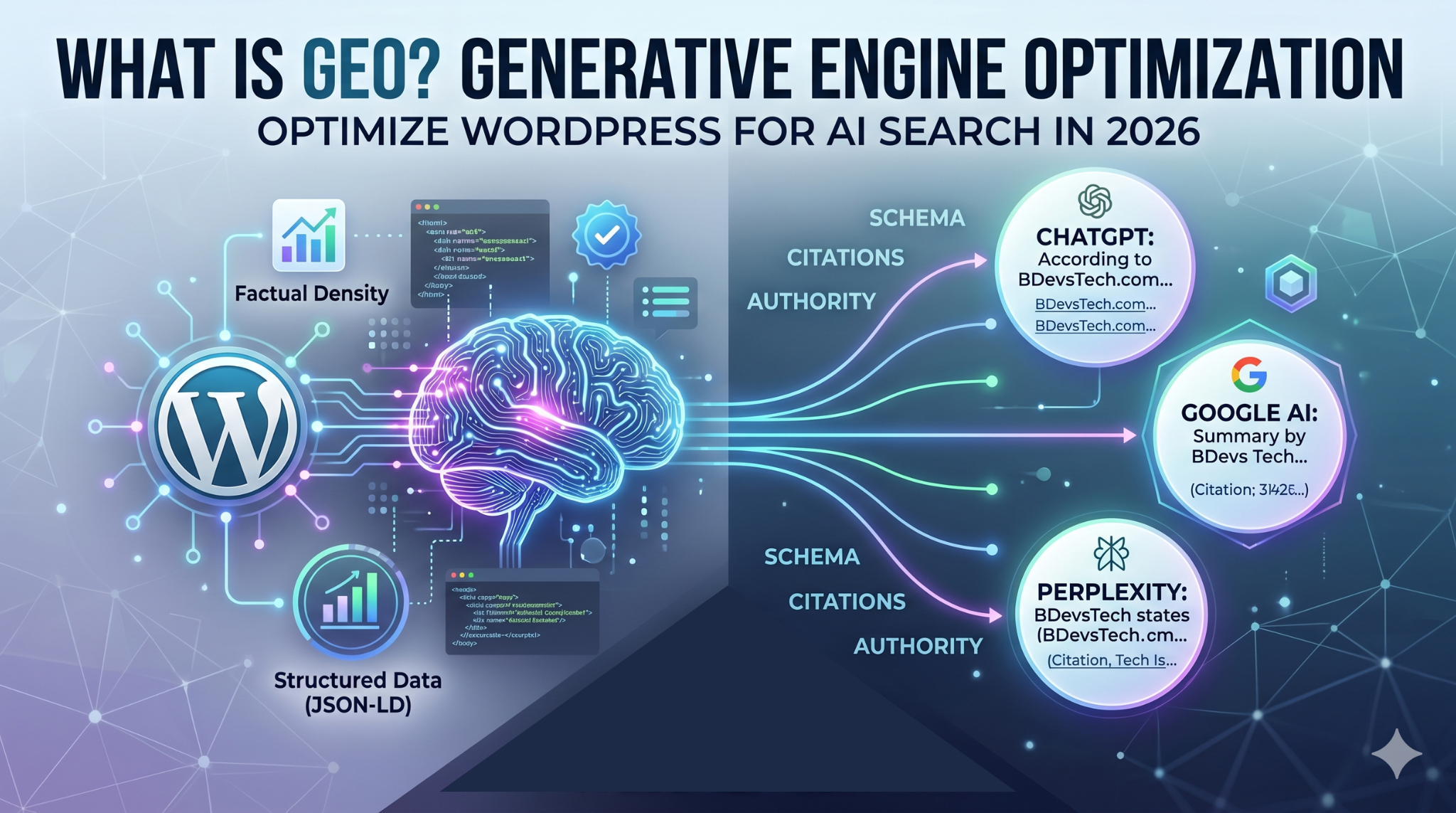
If you have noticed your website traffic shifting in 2026 — fewer clicks from Google, more visitors arriving from AI tools — you’re not imagining it. Generative Engine Optimization (GEO) is the fastest-growing intelligence tool in digital marketing right now. Most developers and websites owners are tracing out the AI Search results and applying the GEO.
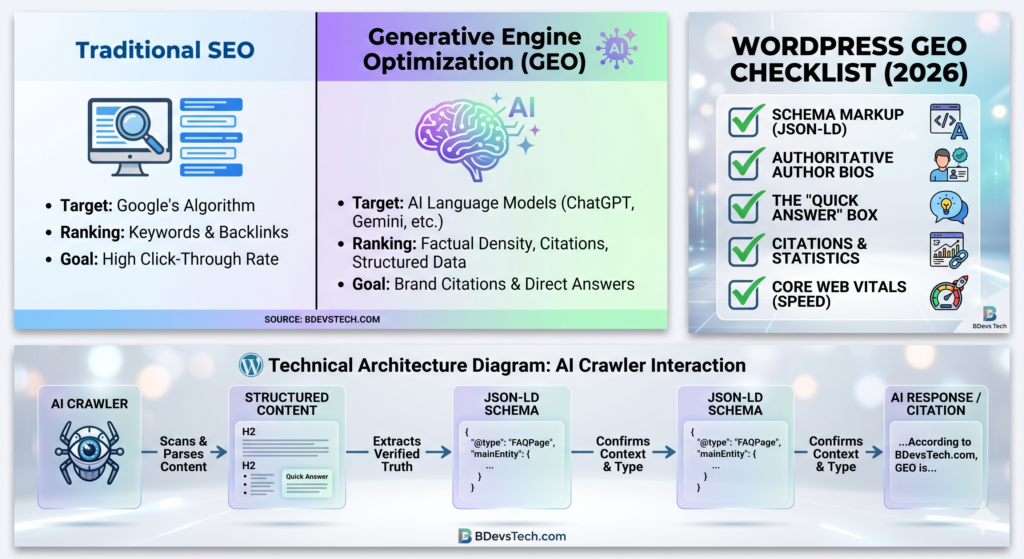
GEO works differently from traditional SEO. AI engines like ChatGPT, Perplexity, and Google AI Overviews don’t rank pages — they read your content, extract the best answer, and deliver it directly to users. Most developers and site owners are now tracking their AI search visibility and adapting their strategy to GEO.
This guide covers exactly what GEO is, why it matters in 2026, and — most importantly — how to implement it on your website today.
What Is Generative Engine Optimization (GEO)?
GEO is the practice of optimizing your content so AI language models cite, quote, and recommend it when answering user queries.
Think of it this way:
- Traditional SEO: Optimize for Google’s algorithm → appear in blue links → user clicks → visits your site
- GEO: Optimize for AI engines → AI cites your content → user sees your site mentioned → visits your site OR gets your answer without clicking at all
When someone asks ChatGPT “What’s the best website hosting for beginners?” and ChatGPT says “According to BDevsTech.com…” — that’s GEO working.
Why GEO Matters More Than Ever in 2026
- Google AI Overviews now appear on 65%+ of searches in tech, health, and finance categories
- ChatGPT processes 100+ million queries per day — many of them replacing Google searches
- Perplexity AI has grown 400% year-over-year and is now a default search for millions
- Studies show AI engines cite sources that have clear structure, expert signals, and specific factual claims — not just the highest DA
Early adopters of GEO are already seeing 30–40% of their referral traffic come from AI sources. Late adopters will struggle as AI continues to reduce Google click-through rates.
Comparison: Traditional SEO vs. GEO (2026)
| SI. No | Factor | Traditional SEO | GEO |
|---|---|---|---|
| 1 | Target engine | Google’s algorithm | AI language models |
| 2 | Ranking signal | Backlinks, authority, keywords | Clarity, facts, citations, structure |
| 3 | Traffic type | Click-through from results | Citations, brand mentions |
| 4 | Content format | Keyword-optimized prose | Factual, quotable, structured |
| 5 | Timeline | 3–6 months to rank | Citations can happen within days |
| 6 | Measurement | Google Search Console | Brand mention tracking, AI query testing |
The 7 GEO Ranking Factors for websites
Research from Princeton, Georgia Tech, and IIT Delhi (2024) identified the content attributes that AI engines prefer when selecting sources to cite. Here’s what they found — and how to apply each one on website in below:
1. Fluency and Authoritative Language
AI engines prefer content that reads as expert-authored. Vague, hedging language (“this might work,” “some experts say”) reduces citation probability.
**WordPress implementation:**
- Rewrite generic introductions. State facts directly: “WordPress powers 43% of all websites globally as of 2026.”
- Add an author bio with credentials to every article (use Rank Math or Yoast author schema)
- Enable **author pages** with LinkedIn profile, credentials, and publication history
**Plugin to use:** Rank Math Pro (author schema) or Simple Author Box.
2. Unique Statistics and Cited Data
AI models are trained to prefer sources that include **specific numbers, dates, and data points** — especially original research.
**WordPress implementation:**
- Include at least 3–5 statistics per article with attribution
- If you have customer data or case studies, publish them as articles: “We Analyzed 200 WordPress Sites: Here’s What Affects Speed the Most”
- Cite authoritative sources (Statista, W3Techs, Google) and link out to them
**GEO signal:** When you cite a stat AND link its source, AI engines trust your content more because the chain is verifiable.
3. Quotable, Self-Contained Answers
AI engines look for passages that directly answer a question in 1–3 sentences. These are called **”AI snippets”** — equivalent to Google’s featured snippets, but for language models.
**WordPress implementation:**
- After every H2 section, write a 2–3 sentence summary that directly answers the implied question
- Use the format: **Question → Direct Answer → Brief Expansion**
4. Structured Data / Schema Markup
Schema markup tells AI engines what type of content your page contains — article, FAQ, how-to, review. This dramatically increases citation probability.
**Critical schema types for WordPress:**
- **Article schema** — every blog post
- **FAQPage schema** — every article with FAQ section
- **HowTo schema** — every step-by-step tutorial
- **Person schema** — author pages
- **Organization schema** — homepage and about page
**WordPress implementation:**
Install Rank Math (free) and enable:
-
-
- 1. Go to Rank Math → Titles & Meta → Posts
- 2. Set “Schema Type” to Article
- 3. For tutorial posts, change to HowTo
- 4. For FAQ sections, use Rank Math’s FAQ block (auto-generates FAQPage schema)
-
No coding required.
5. E-E-A-T Signals (Experience, Expertise, Authority, Trust)
Google’s E-E-A-T guidelines directly influence both Google AI Overviews AND how third-party AI engines evaluate source credibility.
**WordPress implementation checklist:**
-
-
- Author bio on every article: photo, credentials, years of experience, LinkedIn link
- “About” page with team bios, company founding story, client logos
- “As Featured In” section with press mentions (even minor ones)
- Display real reviews and testimonials prominently
- Add a Privacy Policy, Terms of Service, and About page (trust signals)
- Show post dates + “Last Updated” date (freshness = credibility)
-
**Plugin:** WP Review Pro (schema-enabled reviews) + Simple Author Box (author schema)
6. Topical Authority (Content Clusters)
AI engines don’t just evaluate a single article — they evaluate whether your **entire site is an authority** on the topic.
One article about WordPress SEO won’t get cited. A site with 30 interlinked articles about WordPress SEO — covering every sub-topic — signals topical authority.
**WordPress implementation:**
-
-
- 1. Choose 5–8 core topics your site covers
- 2. Build a **pillar article** (3,000+ words) for each
- 3. Write 6–10 supporting articles for each pillar
- 4. Internally link all supporting articles back to the pillar
- 5. Cross-link related supporting articles to each other
-
**Example cluster for BDevsTech:**
– Pillar: “WordPress SEO: The Complete Guide 2026”
– Supporting: WordPress schema markup → Speed optimization for SEO → Internal linking for WordPress → Rank Math complete setup → Core Web Vitals fix → Image SEO in WordPress…
When an AI engine crawls your site and finds 30 deeply interconnected articles on WordPress SEO, it classifies you as an authority. Individual competitors with 2 articles on the topic don’t compete.
7. Content Freshness
AI engines — especially those with live internet access (Perplexity, Bing Copilot) — heavily weight **recently updated content**.
**WordPress implementation:**
-
-
- Add “Last Updated: [Date]” to every article (use Rank Math or manual code).
- Review and update your top 20 articles every quarter.
- Add a “2026 Update” section at the top of older articles noting what changed.
-
**Plugin:** WP Last Modified Info (automatically shows last updated date)
How to test if AI Engines are citing your wordPress site
Method 1: Manual Query Testing
Open ChatGPT, Perplexity, or Google AI Overviews. Ask questions your articles answer:
– “How do I speed up WordPress?”
– “What are the best WordPress plugins for SEO?”
– “How does GEO work?”
Check if your site is mentioned. If not, identify which competitor is cited → analyze what they do differently.
Method 2: Brand Mention Monitoring
Set up Google Alerts for “bdevstech.com” — you’ll get notified when any site (including AI-scraped databases) mentions you.
Use **Mention.com** (free tier) or **Brand24** to track AI-generated mentions across platforms.
Method 3: Perplexity Source Check
Perplexity AI shows its sources. Search your target keywords in Perplexity and study the source list. Those are your direct GEO competitors. Analyze their content structure and match it — then go deeper.
GEO Implementation Checklist for WordPress
**Week 1 — Foundation:**
-
-
- Install Rank Math and configure Article schema on all posts
- Add author bio with credentials to every article
- Add “Last Updated” date to all posts
- Create a complete “About” page with team photos and credentials
-
**Week 2 — Content Structure:**
-
-
- Add FAQ section to your 10 most-visited articles
- Add statistics with citations to every article (minimum 3 stats/article)
- Rewrite article intros to be direct and fact-led (no vague openers)
- Add a 2–3 sentence “Quick Answer” box at the top of every article
-
**Week 3 — Topical Authority:**
-
-
- Map your 5 core topics
- Identify which pillar articles to write first
- Build internal linking map for existing articles
- Start publishing 2–3 supporting articles per pillar per week
-
**Week 4 — Testing:**
-
-
- Test your top 10 articles in ChatGPT, Perplexity, and Google AI Overviews
- Set up brand mention alerts
- Identify 5 competitor articles being cited → plan to beat them
-
WordPress Plugins for GEO
| SI. No | Plugin | Purpose | Cost |
|---|---|---|---|
| 1 | Rank Math | Schema markup (Article, FAQ, HowTo, Person) | Free/Pro |
| 2 | WP Last Modified Info | Last updated date display | Free |
| 3 | Simple Author Box | Author schema + bio display | Free |
| 4 | TablePress | Data tables (AI loves tabular data) | Free/Pro |
| 5 | Elementor or GetGenie AI | Content structuring + AI writing | Citations can happen within days |
| 6 | W3 Total Cache | Site speed (fast sites cited more) | Brand mention tracking, AI query testing |
Leave a Reply